The Dopamine Trap
Why working with AI feels like a superpower, and why that is the problem

Deep Dive #1 in “The Centrifuge” Series — Individual Level
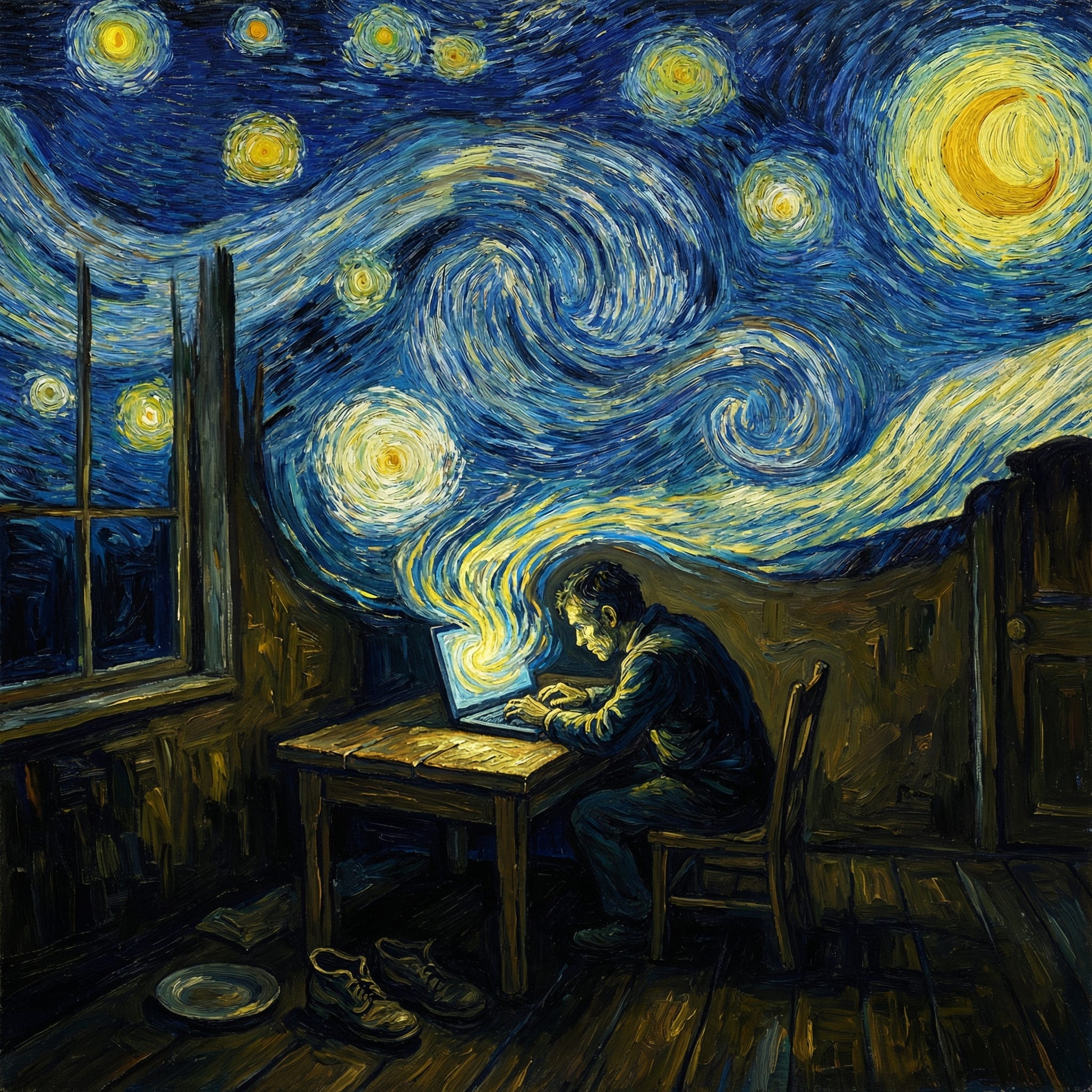
It was a Tuesday in March, around 11pm, when my wife asked me whether I had eaten that day. The answer required genuine effort. Two prototypes shipped, a pitch deck rewritten, a week-old integration bug closed. Also: no food. A doctor’s appointment, booked eight weeks earlier, missed without noticing. No lunch walks. The week before, every day for an hour, done. This week, zero. The walking shoes by the door looked like a reproach.
But the work. The work was extraordinary. Problems dissolved at a speed unimaginable eighteen months before. Every morning, the same feeling upon opening the laptop: let us see what we can build today.
That state is called flow. The other word for it, in retrospect, is trouble.
The dopamine hit from working with AI is not an illusion. It is a neurochemical event, and the most underestimated risk in the current wave of adoption.
Here is the pattern. Frame a problem. The model responds in seconds. Refine. It responds again. Each cycle is a small variable reward, and the brain registers each cycle as a win. The loop tightens. Time compresses. The interval between intention and artifact collapses from hours to minutes to seconds.
Slot machines use the same reward structure. So does genuine creative flow. The difference is invisible from the inside.
Traditional knowledge work came with friction. Walls. Someone would stare at one, get up, make coffee, come back, try again. Walls metabolised the work. They spread cognitive load across hours and days and gave the body permission to rest.
AI removes the wall. Every wall. The tool answers, drafts, debugs, suggests the next step before the current one is finished. The friction that once paced knowledge work is gone, and with it the rhythm that once protected the nervous system.
Mihaly Csikszentmihalyi described flow as optimal experience: high challenge matched to high skill, time dilation, loss of self-consciousness, intrinsic reward. What his research did not describe, because it was not yet possible, was flow on demand. Flow summoned at 8am by opening a laptop and sustained until midnight, without the natural dissolution that used to end it.
Flow was rare because the conditions were rare. The conditions are now always available. A state evolution designed to be occasional is being sustained for ten hours a day, five days a week.
Bodies are not built for this. Cortisol accumulates, sleep architecture degrades, the parasympathetic system never gets its turn at repair. Dopamine masks the deficit, so the feeling is fine. Then one Tuesday evening comes the realisation that lunch never happened, calf muscles are softer, and a friend’s voice has become hard to recall.
The productivity gain is real. The bill arrives later.
One developer described his AI-assisted sprint earlier this year. Six weeks of the best work of his career. He built something he had wanted to build for three years. He also gained nine kilos, started grinding his teeth, and came home one evening to find his partner had booked a hotel. Her explanation: “I cannot keep living with someone who is not here.”
His reply, asked if he would do it again: “In a heartbeat.” The trap, one sentence.
None of this is a story about AI being bad. It is a story about humans being optimised for intermittent effort over millennia, suddenly holding a tool that removes every natural stopping cue. Monkeys with a pellet dispenser that never jams.
What helps, in practice.
Stop measuring output per day. Measure recovery per week. If no single thing this week was purely restorative — a walk without a phone, a meal without a screen, an unhurried conversation — the centrifuge is spinning too fast. The metric that matters is whether Monday begins with a whole person.
Block unassisted hours. Not because AI is harmful, but because the nervous system needs friction the way muscles need rest days. Two mornings a week, work without AI. Paper and pen, uninterrupted thinking. The output of those mornings is slower and frequently better, because it belongs to one person in a way collaborative output does not. The deeper benefit is rhythm memory: the body remembers what a non-accelerated work pace feels like.
Build stop signals into the system. The machine will not tell anyone to stop. Humans have to tell the machine. A hard end time, enforced with something physical: a timer, a walk, a commitment to someone else. The moment of resistance when the urge says to keep going is the signal to stop. Dopamine is not a reliable judge of when enough is enough.
Treat flow as a finite resource. Two or three hours of genuine flow per day is the ceiling. Anything beyond is momentum, not quality. The fourth hour feels identical to the second because dopamine has no diminishing-returns indicator, but the work degrades and nobody notices. Schedule the most important thinking for the first flow window, and hold suspicion toward any sustained state that runs past hour three.
Have a person who can see you. Someone outside the work who will say, honestly, whether the face in front of them is still recognisable. Partners, friends, coaches, therapists. The dopamine trap closes on people who feel fine, which is why an external observer is needed whose judgment outranks any in-the-moment self-assessment about sustainability.
None of this is about slowing down. The speed is real and it is not going back. The distinction is between a sprinter and someone running as fast as they can with no idea where the finish line is. The first will still be running next year. The second gets injured by March.
The individual level of the centrifuge is the one nobody wants to name, because admitting it feels like weakness in a moment that rewards speed. But the people who will still be doing this work in five years will be the ones learning, now, how to ride the acceleration without burning out the engine.
The laptop still opens most mornings with excitement. Afternoons still disappear into flow. What I know now, unknown that recent Tuesday, is that the flow isn’t free, that the body keeps a ledger even when the brain does not, and that the bill, eventually, comes due.
The work is extraordinary. The dopamine is real. The question that matters is not how much can be produced, but how a random Tuesday in March will feel when someone asks whether you have eaten.
Next in the series: Deep Dive #2, The Pace Fracture, on what happens when half the team can ride the spin and the other half cannot.
This essay is part of The Centrifuge, a hub for exploring the human cost of AI acceleration at the individual, team, and organisational level.